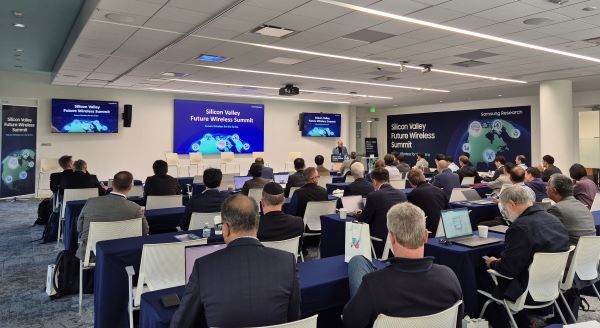
Samsung Electronics held the Silicon Valley Future Wireless Summit in Mountain View, California, on November 6, under the theme “Future Wireless for the AI Era.”
Since the 3rd Generation Partnership Project (3GPP) released the 5G-Advanced standard in March, the industry has expected AI adoption in telecommunications to expand. Interest in next-generation communications technologies using AI is growing as preparations for 6G gather pace.
Samsung Electronics organized the event to share its vision for communications systems powered by AI and its progress in developing the technology.
The company also invited more than 80 experts, including leaders from major telecom operators, manufacturers, government agencies and academia around the world, for in-depth discussions on research priorities and technologies for an AI-driven communications revolution.
Sharing progress in AI-powered communications technology and outlining research priorities for next-generation communications
The event opened with keynote speeches by industry experts on “The Future of Next-Generation Mobile Communications.”
Invited presentations followed across three sessions: AI-Native Communication; Sustainability: Energy Saving & Efficiency; and Innovations to Drive Future Wireless.
The “AI-Native Communication” session featured in-depth discussions on the expected benefits and potential new services enabled by expanding AI across all areas of communications, as well as the challenges to overcome to make this vision a reality.
The “Sustainability” session explored key technologies and research priorities for sustainable 6G systems, including energy savings and improved energy efficiency—areas that are attracting attention as major technology trends.
The “Innovations to Drive Future Wireless” session focused on innovations in 6G network architecture needed to deliver services and user experiences that differ from those of 5G.
Panel discussions in each session also gave participants the opportunity to ask questions and engage in lively, open discussions on each topic.
A technology demonstration session showcased AI RAN technology jointly developed by Samsung Electronics and its partners.
The demonstrated AI RAN technology drew considerable interest. It applies AI to radio access network (RAN) equipment at base stations to optimize quality and improve key performance areas, including spectrum and energy efficiency.
At the event, Samsung Electronics outlined a direction for future communications research through the convergence of AI and wireless technologies and successfully facilitated an exchange of views on global technology developments.
Focusing on better user experiences through AI-powered next-generation communications technology
Samsung Electronics continues to work to expand the global impact of next-generation communications technologies powered by AI.
In February this year, the company joined the AI-RAN Alliance as a founding member and currently serves as a board vice chair and vice chair of the AI on RAN subcommittee. In July, it also pursued 6G research and ecosystem development, including securing the chair position in an International Telecommunication Union (ITU) Radiocommunication Sector 6G standardization group. More recently, Samsung was reappointed vice chair of the board of the U.S.-based Next G Alliance (NGA), further strengthening its leadership in AI-powered communications.
※ AI-RAN Alliance: A global coalition focused on the convergence of AI and radio access network (RAN) technologies. It comprises groups including “AI for RAN,” “AI and RAN,” and “AI on RAN,” and aims to advance 6G research and develop its ecosystem.
※ International Telecommunication Union (ITU): A United Nations agency and international decision-making body for radiocommunication regulations and standards, with 194 member states and more than 1,000 sector members.
※ Next G Alliance (NGA): A private-sector organization led by the Alliance for Telecommunications Industry Solutions (ATIS). It works to secure leadership in 6G through research and development, manufacturing, standardization and commercialization.
In August, Samsung also signed an agreement with Japanese mobile operator NTT DOCOMO to jointly research AI technologies for next-generation communications, further expanding its collaboration with partners.
“Since the introduction of 5G, the communications market has placed growing importance not only on performance improvements, such as adopting innovative technologies like AI and improving energy efficiency, but also on enhancing the user experience,” said Park Jung-ho, executive vice president and head of the Next Generation Communications Research Center at Samsung Research, Samsung Electronics. “Starting with this Future Wireless Summit, we will create opportunities for industry and academic leaders to collaborate and continue research into combining AI and wireless communications technologies to deliver greater value to users and advance communications technology.”
Samsung Electronics plans to continue researching the convergence of AI and wireless communications to enhance the value of the user experience and lead the development of next-generation AI and communications technologies.
Questions about this story?
AI answers only from this article and related ones.
Answered from ten years of our reporting. Check legal and tax questions with a professional.