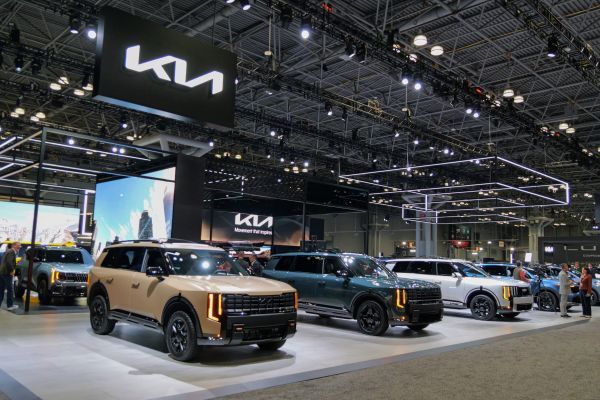
Kia participated in the 2026 New York International Auto Show (the “New York Auto Show”), held on April 1 at the Jacob Javits Convention Center in New York.
At the show, Kia made the North American debuts of the all-new Seltos, which is set to reshape the region’s SUV market, and the Kia EV3, which will help bring electric vehicles to a wider audience. The debuts underscored the company’s commitment to expanding its market share and strengthening its brand competitiveness in North America.
At a press conference, Eric Watson, vice president of sales at Kia America, said, “Kia sold more than 850,000 vehicles in the U.S. last year, setting a new annual sales record for the third consecutive year. With the launch of the all-new Telluride, which is drawing strong interest in the local market, we will further strengthen our position in the U.S.” He highlighted the company’s sales performance and growth ambitions in the market.
“In response to rapidly growing demand for hybrid vehicles in North America, Kia plans to expand hybrid models across its SUV lineup,” said Yun Seung-kyu, president of Kia’s North American regional headquarters and Kia America. “Starting in late May this year, we plan to produce the Sportage Hybrid—the largest-volume segment in North America—at Hyundai Motor Group Metaplant America (HMGMA) to meet local demand. We expect this to support Kia’s continued growth and strengthen its competitiveness in the North American market.”
He added, “Under our brand message, ‘Inspiration connects us all,’ Kia is supporting the dreams and ambitions of future generations by selecting children to take part in the FIFA World Cup 2026™ Official Match Ball Carrier (OMBC) program and hosting the OMBC Cup.”
From April 1 through Sunday, April 12 (local time), Kia will display 21 vehicles across a 1,769-square-meter (approximately 535-pyeong) exhibit space at the New York Auto Show. The lineup includes the K4, K5, EV6, Telluride, Sorento, Sportage and Carnival.
All-new Seltos, a classic SUV with sophisticated, forward-looking design, debuts in North America
The Seltos, launching in North America, is a core model in Kia’s global SUV lineup. It builds on the first-generation model’s refined design and practicality while adding a range of advanced features and improved space utilization, offering North American customers a distinctive mobility experience.
Alongside the gasoline models, Kia will also launch a hybrid model to meet rising demand in North America. It is expected to be an ideal choice for customers seeking both efficiency and environmental benefits.
The new Seltos Hybrid pairs a 1.6-liter hybrid powertrain with excellent fuel economy and delivers an electrified driving experience close to that of an EV.
Gasoline models will be offered with either a 1.6-liter turbocharged engine or a 2.0-liter engine.
The 1.6-liter turbocharged model delivers 190 horsepower (HP) and pairs with an eight-speed automatic transmission for smooth shifts and an improved driving experience.
The 2.0-liter gasoline model pairs with an intelligent variable transmission (IVT) and delivers 147 horsepower (HP).
Based on Kia’s design philosophy, Opposites United—the creative convergence of contrasting concepts—the Seltos combines the rugged character of a classic SUV with a forward-looking image.
The body is approximately 60 mm longer than that of the first-generation model, with a 2,690 mm wheelbase—among the longest in its class. This creates a more commanding stance while providing a spacious, practical cabin.
The design-focused X-Line trim heightens the vehicle’s dynamic, bold look with exclusive bumpers, skid plates and side sills.
Unlike the first-generation model, the new Seltos also features auto-flush door handles for a cleaner, more aerodynamic exterior.
Inside, a column-mounted electronic shift lever frees up console space. A panoramic wide display, seamlessly integrating a 12.3-inch instrument cluster, a 5-inch climate-control display and a 12.3-inch infotainment system, makes the front of the cabin feel even more spacious.
The longer wheelbase increases second-row legroom, delivering best-in-class rear-seat room. Cargo capacity is approximately 786 liters under the SAE standard, or about 1,817 liters with the second-row seats folded. A two-level cargo floor and Kia AddGear further enhance practicality.
The Seltos features Kia AI Assistant, which uses generative AI to enable two-way interaction between the vehicle and its occupants. Kia has also enhanced connectivity, allowing customers in North America to access popular entertainment and convenience features through over-the-air (OTA) services in the Kia Connect Store.
Customers can use streaming services such as YouTube, Disney+ and Netflix, as well as gaming apps, in the vehicle. They can also apply display themes featuring Disney, Marvel and Star Wars characters, along with themes for the NBA and FIFA World Cup 2026™, both officially sponsored by Kia.
Designed for the North American market, where private homes and garages are common, Kia myQ Connected Garage can automatically open or close the garage as the vehicle approaches, or allow remote control through the in-vehicle display.
To support comfortable, safe driving, Kia has made Forward Collision-Avoidance Assist, Lane Departure Prevention Assist, Lane Following Assist 2, Intelligent Speed Limit Assist and Driver Attention Warning standard across all Seltos trims.
Other driver-assistance features include Highway Driving Assist 1, Navigation-Based Smart Cruise Control, Smart Cruise Control, Surround View Monitor, Blind-Spot View Monitor, Blind-Spot Collision-Avoidance Assist, Rear Parking Collision-Avoidance Assist and Safe Exit Warning. Together, they help drivers manage potential hazards while driving, parking and exiting the vehicle.
Kia plans to launch the Seltos 1.6-liter turbocharged and 2.0-liter gasoline models in the U.S. in the second quarter of 2026, followed by the 1.6-liter hybrid in late 2026.
EV3, a dedicated compact electric SUV set to bring EVs to a wider audience, debuts in North America
Launching in North America this year alongside the Seltos, the EV3 is Kia’s most accessible EV in the local lineup. It offers customers’ preferred advanced features at a competitive price and is expected to accelerate the North American market’s transition to electric mobility and transform consumer lifestyles.
The EV3’s interior and exterior blend refined, geometric design based on Kia’s Opposites United philosophy. Star Map Signature Lighting and vertically arranged small-cube LED projection headlights form the “Tiger Face,” conveying a bold, futuristic character.
The vehicle also features short overhangs and a floating roofline that slopes toward the rear. Aerodynamic wheels, active air flaps and a full underbody cover optimize airflow.
Inside, a panoramic wide display creates a cohesive visual experience for the driver, while reclining second-row seats improve passenger comfort on the move.
The Nightfall Edition, exclusive to the U.S. market, features black exterior accents and emblems, paired with a dark gray interior for a more understated, sophisticated look.
In North America, the EV3 will be offered as a long-range model with an 81.4 kWh battery and a standard model with a 58.3 kWh battery.
For convenient charging, the EV3 comes standard with a North American Charging Standard (NACS) port. With a 350 kW fast charger, the standard model can charge from 10% to 80% in 29 minutes.
The vehicle also offers Plug and Charge (PnC), which automatically handles authentication, charging and payment when the vehicle is connected to a charger, for an easy, convenient charging experience.
The EV3 features i-Pedal 3.0, which allows drivers to accelerate, decelerate and stop using only the accelerator pedal at any regenerative braking level, improving both driving convenience and passenger comfort. It also offers Vehicle-to-Load (V2L), which can supply power to external devices in a range of situations.
The EV3 is equipped with a range of advanced safety features and driver-assistance functions to support comfortable, safe mobility.
With Kia AI Assistant, powered by generative AI, customers can more easily use navigation and control vehicle functions using natural language. Advanced connectivity also enables access to streaming services such as YouTube, Disney+ and Netflix in the vehicle.
Other convenience features include Digital Key 2.0, a 12-inch head-up display (HUD), a Harman Kardon premium audio system, wireless smartphone charging and Kia myQ Connected Garage.
Safety features include Highway Driving Assist 2, Forward Collision-Avoidance Assist and Lane Following Assist. The EV3 also offers a Surround View Monitor, Remote Smart Parking Assist and Rear Parking Collision-Avoidance Assist to help ensure safety and convenience while driving and parking.
Kia plans to launch the EV3 in the U.S. in the second half of 2026, in five trims: Light, Wind, Land, GT-Line and GT.
The EV3 GT delivers powerful performance with a dual-motor system. It also features GT-exclusive interior and exterior design details, including neon brake calipers, as well as driving-focused features such as a virtual gear-shift system and Active Sound Design for a sporty driving experience.
PV5 WAV New York taxi concept unveiled to transform mobility for people with limited mobility
At the New York Auto Show, Kia also unveiled a PV5 WAV concept developed in partnership with North American mobility specialist BraunAbility. The vehicle is designed to transport passengers who use wheelchairs.
The PV5 WAV concept is an EV-based, New York taxi concept developed with BraunAbility, one of Kia’s global conversion partners for its PBV (Platform Beyond Vehicle) business and a specialist in wheelchair-accessible vehicle (WAV) conversions. It was designed to advance sustainability through the transition to clean energy—a key value in future mobility—and improve accessibility for wheelchair users.
Taking advantage of the flexibility of Kia’s PBV platform, which makes it easy to develop and build specialized models tailored to customers’ needs and uses, Kia minimized modifications to the PV5 to maximize vehicle quality. Its low-floor design, based on the dedicated E-GMP.S platform, makes entry and exit easier for both wheelchair-using passengers and drivers.
Using the concept as a foundation, Kia also conducted a proof-of-concept (PoC) project in New York—one of the world’s most iconic taxi markets—in partnership with government agencies, disability organizations and facilities, and ride-hailing platforms. Based on feedback from passengers and fleet managers during the project, Kia plans to produce high-quality WAVs to provide wheelchair users with safer, more convenient mobility.
Questions about this story?
AI answers only from this article and related ones.
Answered from ten years of our reporting. Check legal and tax questions with a professional.