“Holssi,” a lodging information-sharing platform for long-distance hikers, has officially launched.
With the 4,500-kilometer Korea Dulle-gil completed on the 23rd, hiking has become one of the core attractions of tourism in South Korea. As the infrastructure for hiking has taken shape, digital services that make hiking safer and more convenient are also emerging.
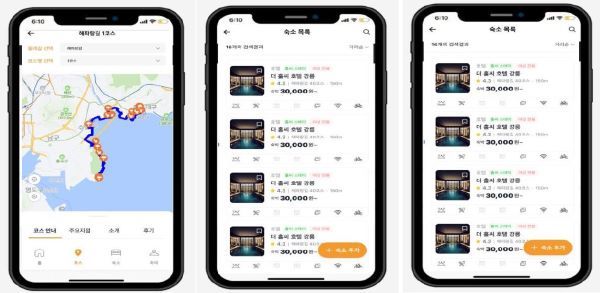
Holssi combines navigation for hiking routes with lodging information. Its smartphone app guides users along hiking routes and uses location-based services to show accommodations within 300 meters of the trail. It currently covers the Jeju Olle Trail, the Korea Dulle-gil, the Jirisan Dulle-gil and sections of the East-West Trail that have opened, with data on about 4,000 accommodations. Built as an information-sharing platform for long-distance hikers in South Korea, the app launched to coincide with the completion of the Korea Dulle-gil, and full-scale service is now underway.
For long-distance hikers, route navigation is directly tied to safety, while lodging near trails is key to convenience. South Korea has few accommodations close to hiking routes, so hikers often have to leave the trail to stay in nearby tourist areas or small cities, then return the next day. This contrasts with Spain’s Camino de Santiago, which draws 500,000 visitors a year and owes part of its success to albergues. These affordable lodgings sit alongside the pilgrimage route, typically in villages spaced about 15 kilometers apart.
Taking inspiration from the Camino de Santiago, Holssi is working to expand lodging along hiking routes. In August, it opened its flagship accommodation, Holssi Station, on Ganghwa Island, where Course 104—the final section of the Seohaerang Trail—meets Course 1 of the DMZ Peace Trail. The company plans to continue expanding its lodging certification program through next year, identifying at least one certified business on every route and certifying about 300 establishments.
Holssi plans to grow into a platform for long-distance hikers, sharing not only lodging information but also details on restaurants, restrooms, rest areas and other essentials for hiking.
The Holssi initiative, which expands lodging infrastructure along hiking routes, is also expected to help address the risk of population decline in regional areas by increasing the number of people who spend time there. In recognition of its public value and growth potential, Holssi was selected for support under the Korea Tourism Organization’s tourism venture program for the second consecutive year, in both 2024 and 2025.
Park Young-soo, CEO of Dotom, which developed Holssi, left his IT job in March last year to start the company. “I realized how difficult it is to find accommodations along hiking routes in South Korea, and how this makes hiking unnecessarily expensive,” Park said. “I founded the company while looking for a way to solve the problem.” He added, “Building on South Korea’s IT infrastructure and growing enthusiasm for hiking, we plan to develop Holssi into a leading platform that shares information hikers truly need.”
Questions about this story?
AI answers only from this article and related ones.
Answered from ten years of our reporting. Check legal and tax questions with a professional.