BNRI announced the launch of Reader’s Eye, an eye-tracking solution that scientifically assesses reading comprehension.
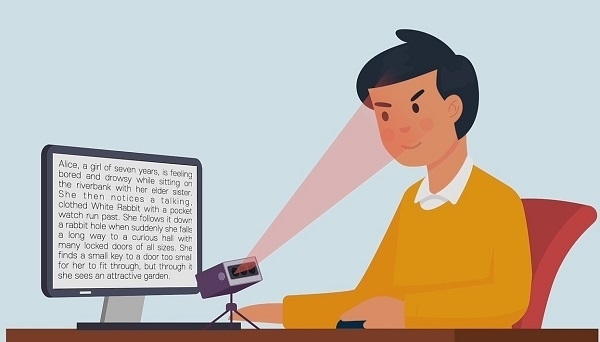
Reader’s Eye uses a specialized camera to capture eye movements as users read text on a screen and answer questions, evaluating their reading fluency from multiple perspectives. Unlike conventional paper-based tests, it uses biometric data to systematically and scientifically identify problems in the reading process.
Reader’s Eye is a program developed using eye-tracking and machine-learning technologies.
Eye tracking detects gaze movements using infrared light to determine what a person is looking at, and has long been used in reading comprehension research. It captures dozens of characteristics, including how long a person’s gaze stays on text, the distance and speed it travels, and its angle of movement. Analysis of this data makes it possible to objectively assess how fluently someone reads, whether they consistently take in all the information, how effectively they find relevant content, and how quickly and accurately they can read large amounts of text.
Reader’s Eye is a web-based program trained on data collected nationwide using machine learning. It assesses readers’ fluency, concentration, and scanning skills, and analyzes their reading cognition. In particular, it identifies habits that hinder fluent reading, which could make it especially helpful for teaching children who are just beginning to read.
Reader’s Eye was selected in 2017 for the Ministry of SMEs and Startups’ technology support program for innovative small and medium-sized enterprises. Researchers from Korea National University of Education’s Department of Elementary Education also took part as a commissioned research institution, and development continued for three years.
In 2020, the program will undergo field testing with the Seoul Metropolitan Office of Education’s Department of Elementary Education. The test will use Reader’s Eye to assess and monitor the reading skills of students managed by the city as part of efforts to ensure basic academic proficiency.
Reader’s Eye was designed for distribution to organizations that need to assess reading comprehension while providing reading instruction, including libraries and private academies as well as schools. It can also be used to assess reading in foreign languages, including English, and may therefore help evaluate foreign-language proficiency. Institutions can create individual student accounts to systematically track their reading skills.
Ryu Gijeong, head of research at Reader’s Eye, said, “Despite the importance of reading skills, children are simply told to read more books, and no one systematically teaches them about reading problems or how to address them. I hope Reader’s Eye will help teachers and parents identify children’s reading difficulties and provide systematic guidance.”
Reader’s Eye: https://www.readerseye.com/https://www.readerseye.com/
Questions about this story?
AI answers only from this article and related ones.
Answered from ten years of our reporting. Check legal and tax questions with a professional.