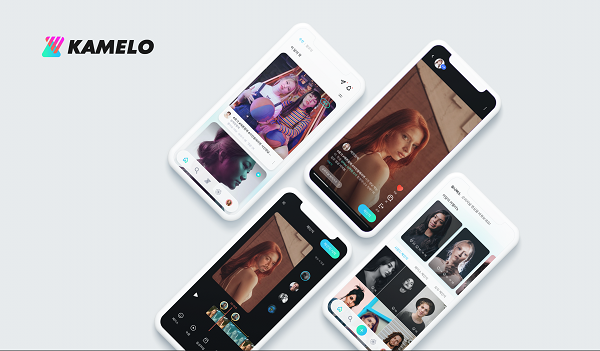
Klleon, a culture-focused AI company, announced on the 24th the official launch of Kamelo, a video-sharing social media app that lets users create videos without filming.
Kamelo combines “chameleon” and “hero” in its name, reflecting its ability to change a video’s star at any moment. Anyone can create and share videos by replacing the faces and voices of people in existing footage in near real time. Users simply tap the “Change” button on a video to replace its subject with a face and voice of their choice. Adding new elements to existing videos lets users re-create them in dozens or even hundreds of ways.
Users can keep creating original video content, from dancing onstage with BTS to inventing their own alter egos as virtual characters who do not exist in real life.
Kamelo uses a range of AI technologies beyond face and voice replacement, offering users a wider variety of content. Features include New Face, which lets users adjust the weighting of two or more face photos and combine them freely to create a new face; Makeup, which applies a chosen look to specific areas of a face; and Fun Sound, which changes the tone of a person’s voice in a video. Users can then use these newly generated video elements to “Change” footage and create their own videos.
The face-swapping app Reface was also a hit, drawing an explosive global response, including from Elon Musk, who posted a face-swapped image on Twitter. Kamelo stands apart as more than a simple tool for creating altered videos: it is a new kind of social media platform where users can share their creations and interact, with the ability to change and generate voices as well as faces.
“We are currently in the process of establishing offices in the United States and Japan,” said Klleon CEO Jin Seung-hyuk. “Our goal is to grow KAMELO, a deep-learning video social platform, into a global app enjoyed in more than 120 countries by 2023.”
After launching in South Korea this year, Kamelo said it plans to begin a full-scale global rollout in 2022, starting with the United States and Japan, major content markets. The effort will build on its proprietary speech-to-speech translation (STS) technology. In addition to personalized text-to-speech (P-TTS), the technology can translate speech into Korean, Chinese, Japanese and English. It reproduces native-speaker pronunciation using trained data and requires only about 30 seconds of speech. By contrast, existing P-TTS technology requires training on roughly 300 to 500 sentences, making this a dramatic reduction in both time and data.
Starting in the fourth quarter of 2021, Kamelo plans to test the app’s market potential in 140 countries in the first quarter of 2022, then enter a total of 60 countries and localize the app by the fourth quarter of 2022.
Klleon: https://klleon.io/
Questions about this story?
AI answers only from this article and related ones.
Answered from ten years of our reporting. Check legal and tax questions with a professional.