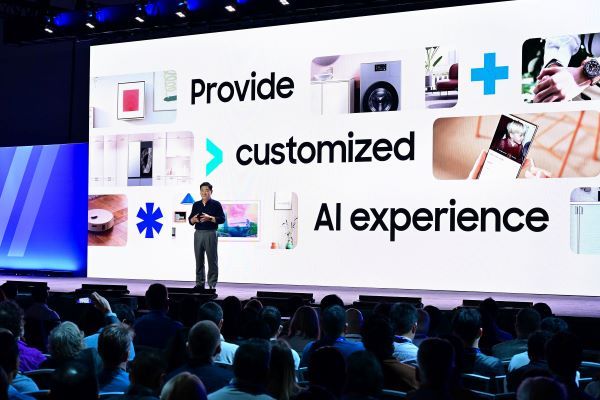
Samsung Electronics held Samsung Developer Conference (SDC) 2024 on October 3 at the San Jose McEnery Convention Center.
SDC is a global event where Samsung shares its vision and innovations in software, services and platforms. This year marked the conference’s 10th anniversary.
Held under the theme “AI for All—A Decade of Open Innovation and Beyond,” the event drew about 3,000 developers, partners and media representatives from around the world.
Samsung shared its vision of delivering more personalized and secure experiences through AI across multiple devices, and introduced the latest technologies to bring that vision to life.
In his keynote, Samsung Electronics Vice Chairman and CEO Jong-Hee Han, head of the DX Division, said, “We’ve been able to continue our journey of innovation thanks to the efforts of developers and partners over the past 10 years.” He emphasized open collaboration to strengthen competitiveness in the AI era and support mutual growth.
He also outlined △the growing importance of security in the AI era △the latest AI technologies for more personalized experiences and family care △and Samsung’s commitment to expanding AI in B2B.
“Samsung is preparing to deliver more advanced personalized experiences by recognizing ‘who is speaking’ and ‘which space they are in,’” Han said. “These services will be made more convenient and secure through Samsung’s AI-powered software and platform innovations and security technologies.”
For example, Samsung is pursuing a range of scenarios, including △recognizing only family members’ voices so outsiders cannot control devices △and using connected home devices and sensors to detect where users are and adjust temperature and humidity based on their usual patterns.
Han said Samsung is considering expanding the SmartThings hubs built into its TVs, smart monitors and Bespoke AI Family Hub refrigerators to appliances with screens. This would allow users to connect third-party devices without a separate hub, while Edge AI would enhance AI capabilities on connected devices in the home.
※ Edge AI: A method of processing data on high-performance devices in the home without sending it to the cloud. It can enable faster data processing and improve security.
Starting next year, Samsung will unify the name of the software experience across its major product lines—including TVs and home appliances, in addition to mobile devices—under “One UI.” Software upgrades for each product will be guaranteed for up to seven years, giving users access to the latest features and making the experience more consistent across products.
In addition to Han, Samsung employees and industry representatives introduced a range of strategies and visions at the event. Topics included △Samsung’s AI research priorities and security technologies △AI-powered software experience improvements across major products △the Tizen OS △and the evolution of the SmartThings platform.
AI across product lines delivers secure, personalized experiences across multiple devices
Samsung shared plans to bring AI technologies tailored to each product—from mobile devices to TVs and home appliances—to all product lines, then connect those products to create more personalized AI experiences.
To advance personalized AI experiences, Samsung is combining secure on-device AI with high-performance cloud AI. It is also focusing on privacy and security research to support the continued development of generative AI.
Samsung also highlighted its efforts to deliver responsible AI. Guided by three principles—fairness, transparency and accountability—the company provides structured training and review processes to help employees follow its AI ethics principles throughout the use of AI technologies.
On security, Samsung said Knox Matrix, first unveiled in 2022, will expand beyond mobile products to TVs and home appliances, significantly strengthening security among connected devices.
Passkey, which improves both security and convenience, will support Samsung accounts as well as web browser sign-ins. It will first be available on TVs and Bespoke AI Family Hub refrigerators launching next year, as well as appliances with the AI Home feature and its 7-inch LCD touchscreen.
Improving user experiences with Galaxy AI, Bespoke AI appliances and AI-powered screens
Samsung plans to enhance personalized experiences for customers through Galaxy AI and expand AI across its ecosystem.
Samsung said it will deepen open collaboration with Google and other companies to extend AI experiences. It also said One UI 7, due to be unveiled later this year, will expand Galaxy AI features and deliver a completely refreshed user experience with a more refined, striking and expressive UX.
Samsung highlighted features in its Bespoke AI appliances, including △AI Vision Inside in the Bespoke AI Family Hub refrigerator △and AI floor recognition in the Bespoke AI Steam robot vacuum. The company said AI features optimized for each product are transforming customers’ daily lives.
Looking ahead, Samsung said △AI Home, with a 7-inch screen and the SmartThings app △and Bixby, its upgraded AI voice assistant, will enhance personalized experiences and improve accessibility.
Samsung, which helped usher in the era of AI TVs, also redefined the role of the TV. The company said TVs now provide information users need in their daily lives, beyond the viewing experience, and offer personalized services by connecting with other devices in the home.
For example, the Daily Board feature displays the status of connected home devices even when users aren’t watching TV, and provides useful everyday information such as energy use, weather and notes. Samsung added that integrating local network services such as NextDoor could make local information tailored to users’ interests more readily available.
Samsung also introduced Samsung AI Cast, which lets users send AI-generated results from a mobile device directly to a TV. Users can view AI-generated images on a large screen or check a list of content they want to watch directly from the home screen.
Samsung also emphasized the importance of AI in B2B. The company introduced △VXT (Visual Experience Transformation), a next-generation cloud-based signage solution platform △CMS (Content Management Solution) for AI-powered content creation, operations and management △WiNE (Widget aNd Extension), which lets users explore solutions from a range of AI partners in the market △and PIRS (Pre-Integrated Repeatable Solution), partner-specific apps built using a framework.
Tizen OS evolves with personalized experiences, efficient upgrades and greater openness
Samsung said Tizen OS will bring AI features to more devices, including TVs and home appliances with 7-inch screens, such as the Bespoke AI Family Hub, Bespoke AI Combo washer-dryer and induction ranges.
Samsung also said it plans to enhance on-device AI to offer more personalized services. In particular, Tizen AI services powered by Samsung’s NPU (Neural Processing Unit) chip optimize AI models for Samsung products and users, enabling smarter and more secure experiences. Samsung said the technology currently reduces audio echo and noise during video calls on TVs and improves note-taking solutions on electronic whiteboards by predicting users’ handwriting styles.
Samsung also introduced significantly improved connectivity between Tizen and Galaxy devices. Multi Control, which lets users share a keyboard and mouse across smartphones, tablets and notebook PCs, now also supports smart monitors and TVs, making it easier to use.
Samsung has completed development of a RISC-V-based Tizen OS for developers and plans to release the related SDK in 2026.
Samsung also plans to continue supporting △the latest version of Flutter, a leading cross-platform development framework △and a range of developer extension tools that enable more detailed debugging and profiling during app development.
SmartThings, a leading global connectivity platform, evolves with AI and expands into health
Samsung said SmartThings has grown into one of the largest connected platforms and a leading global platform over the past 10 years, with more than 350 million users and over 340 WWST-certified partners.
Samsung said that by integrating AI into SmartThings and expanding open partnerships, the platform will become a game changer that differentiates Samsung products and services.
The company also demonstrated Home Insight, a service scheduled to launch in October. Powered by SmartThings, it analyzes users’ daily patterns, device usage history, and the status of devices and the home to provide real-time reports and timely recommendations for useful features. For example, if connected devices indicate that a home is empty, it can suggest that users turn off devices they don’t need while away.
※ As of October 2024, Home Insight’s summary and recommendation features are available in South Korea and the United States, with expansion to other regions planned in stages. Supported devices include Samsung smart TVs, Galaxy smartphones and tablets, with more to be added later.
The Galaxy Tab S10 series also includes a Home Insight widget, letting users conveniently monitor and control their home from the large screen, much like a home dashboard.
Samsung Electronics also introduced several partnerships. Building on its work with smart lock companies such as Aqara and Solity, the company said SmartThings’ Door Lock feature will be added to Samsung Wallet as a digital home key next year, making access more convenient.
Laura Kohler, chief sustainability officer at U.S. bathroom and kitchen products company Kohler, took the stage to discuss its SmartThings partnership. In the future, users will be able to monitor and reduce water use through connected showers and faucets.
In a video message, Tobin Richardson, president and CEO of the Connectivity Standards Alliance (CSA), said SmartThings is playing a pivotal role in building the Matter ecosystem, including by becoming the first to implement the Matter 1.3 standard.
SmartThings plans to expand the customer experience by connecting Samsung Electronics’ Samsung Health platform with a range of health and fitness devices.
Girish Naganathan, CTO of continuous glucose monitoring company Dexcom, took the stage and said the collaboration with Samsung Electronics will give users a more convenient way to manage their health at home with personalized care.
Harman and C-Lab startups share AI insights and innovative technologies
Samsung Electronics subsidiary Harman also took part in technical sessions, presenting cross-platform monetization strategies to help companies keep pace with trends in software-defined vehicle (SDV) development. It also showcased software solutions that can unlock opportunities in the automotive app market through streamlined developer tools and resources.
Startups supported and nurtured by Samsung Electronics’ C-Lab program returned to the SDC exhibition for a second year. Three startups backed by C-Lab Outside, the program for startups outside Samsung, took part: OMNIOUS.AI, which offers a hyper-personalized AI commerce solution; Cochl, which develops audio AI solutions; and Ghost Pass, which provides decentralized biometric authentication and security solutions. EDINT, a spin-off from the company’s internal venture program, C-Lab Inside, showcased innovative education technology, including an AI-powered online exam proctoring service.
Samsung Electronics plans to actively support C-Lab startups at SDC, helping them gauge global market response, strengthen their business prospects and explore partnership opportunities.
Questions about this story?
AI answers only from this article and related ones.
Answered from ten years of our reporting. Check legal and tax questions with a professional.