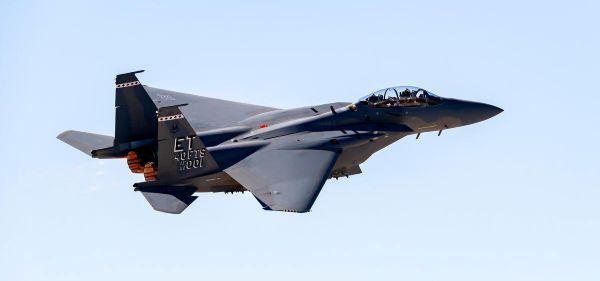
Hanwha Systems said on the 18th that it has signed a contract to supply its Eagle Large Area Display (ELAD) for South Korea’s latest F-15K fighters and the U.S. Air Force’s F-15EX fighters, both produced by Boeing, the world’s largest aircraft manufacturer and a leading U.S. defense company.
The deal was made possible by government-led industrial cooperation and trade diplomacy, including efforts by the Defense Acquisition Program Administration’s Aircraft Program Bureau, as well as Hanwha Systems’ accumulated avionics expertise. Last November, as it pursued the major foreign procurement program to upgrade the F-15K, DAPA signed a memorandum of understanding (MOU) on industrial cooperation with Boeing to expand opportunities for South Korean companies to participate.
After sustained efforts to help South Korean companies join global suppliers’ international supply chains, Hanwha Systems was selected to supply large-area displays for Boeing’s F-15 cockpits, opening the door to the U.S. market.
Hanwha Systems’ ELAD combines information previously spread across multiple instrument panels on a single large screen, giving pilots rapid access to critical cockpit information, improving situational awareness and increasing mission efficiency. Pilots can intuitively view the information they need on one screen and send commands to the mission computer (MC) through a touch-based interface. This operating concept is considered a key element of the cockpit environment in modern fighter aircraft.
Hanwha Systems also supplies seven essential avionics systems for the KF-21, South Korea’s homegrown fighter. It has developed the mission computer (MC), the “pilot’s eyes”—the multi-function display (MFD)—the audio communication control system (ACCS), and the terrain-following computer (TFC) using wholly domestic technology, contributing to the KF-21’s localization. In addition, the company developed the AESA radar with the Agency for Defense Development after the United States refused to transfer the technology. It has also localized and is supplying the KF-21 with an infrared search and track system (IRST) and an electro-optical targeting pod (EO TGP).
Hanwha Systems’ ELAD for Boeing will draw on the company’s expertise in developing the MFD installed on the KF-21. It will be designed and built to suit the F-15EX’s characteristics, cockpit layout and mission environment.
The U.S. Air Force’s F-15EX is the latest model in the F-15 series. It offers high weapons payload capacity, long range and expandability based on an open architecture. F-15-series fighters are operated by the United States, South Korea, Japan, Singapore, Israel, Saudi Arabia and other countries, and cockpit modernization is ongoing.
* Open systems architecture: A systems design approach that enables interoperable, connectable systems without modification or redesign.
Starting with this contract, Hanwha Systems expects its equipment to be incorporated into the F-15 upgrade program, bringing South Korean technology into the process in a significant way.
Hanwha Systems supplies multi-function radars (MFRs) for the Cheongung-II medium-range surface-to-air missile system, which it has exported to several Middle Eastern countries, including the UAE, Saudi Arabia and Iraq. The company has also exported combat management systems—the “brains” of a ship—to 13 Philippine vessels, including frigates, corvettes and offshore patrol vessels. Last year, it supplied AESA radar antenna units to Italy’s Leonardo, expanding its presence in global markets across Europe, the Middle East and Southeast Asia.
The Boeing contract opens the door to the U.S. market for Hanwha Systems and demonstrates that its export diversification strategy is gaining momentum.
Hanwha Systems said the ELAD export is significant in itself because it shows that the technology and quality of its avionics have been recognized in the U.S. domestic market. The company said it would continue to expand business opportunities in the global avionics market, including the United States, in cooperation with the government and DAPA. It also said it would continue advancing the ELAD’s technology so it can be used in South Korea’s F-15K upgrade program, as well as future U.S. F-15 upgrades and global next-generation fighter programs.
Questions about this story?
AI answers only from this article and related ones.
Answered from ten years of our reporting. Check legal and tax questions with a professional.