LG CNS has made a strategic investment in U.S. robotics company Dexmate, becoming the first Korean company to do so, to strengthen its capabilities in humanoid robot hardware optimized for industrial sites. The investment was made through LG Technology Ventures, LG’s corporate venture capital arm.
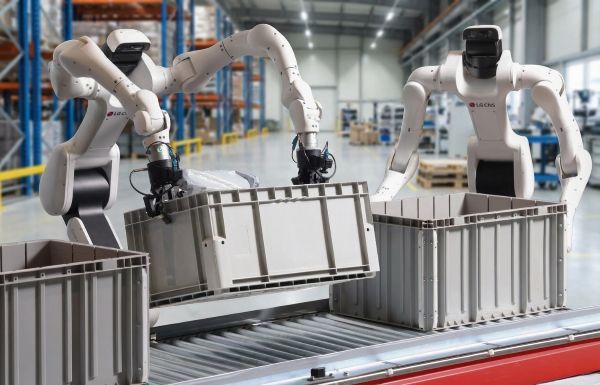
Based in Silicon Valley, Dexmate builds humanoid robots whose quality and performance have earned them recognition as standard research hardware among leading global developers of robot brains. The robots retain the task capabilities of human-shaped robots while using wheels instead of legs for stable operation over long periods.
The robots consist of a wheeled base, two arms designed for high-speed work, and a head equipped with vision sensors to detect the surrounding environment. With more than 36 degrees of freedom, they can perform precise, coordinated tasks with both hands. The arms support a payload of about 15 kg, and the robots can operate for more than 20 hours on a single charge. Their more stable base than that of bipedal humanoid robots makes them well suited to a range of industrial settings, including logistics centers and manufacturing plants.
With this investment, LG CNS has added wheeled humanoids to its lineup of robot hardware, which already includes bipedal humanoids and quadruped robots. The company plans to offer a “full-stack RX service” that combines three key elements for commercializing humanoid robots: hardware, a Robot Foundation Model (RFM), and an operations and training platform.
LG CNS is developing its own platform for robot operations and training while continuing to expand partnerships and investments in the robotics business. In June last year, it invested in U.S. robot-brain developer Skild AI and formed a partnership to advance industry-specific RFMs. The company is also conducting multiple proof-of-concept (PoC) projects using robots trained on data from logistics, retail, and manufacturing sites. It is testing the robots’ ability to perform real-world tasks, such as loading and sorting goods at logistics centers and manufacturing plants, and inspecting ship assembly and quality.
“This investment is a strategic move by LG CNS to integrate robot hardware, RFMs, and platforms, enabling large-scale robot operations and accelerating adoption across industrial sites,” said Lee Jun-ho, executive vice president and head of the Smart Logistics & City Business Division at LG CNS. “By demonstrating humanoid robot business models that can be deployed immediately in real-world settings—not just validating the technology—we will lead the era of physical AI.”
Questions about this story?
AI answers only from this article and related ones.
Answered from ten years of our reporting. Check legal and tax questions with a professional.